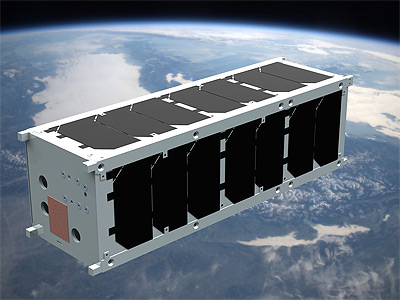
The Student Aerothermal Spectrometer Satellite of Illinois and Indiana (SASSI²) mission characterizes the flow and radiation generated by the diffuse bow shock formed by a 3U CubeSat falling through the upper atmosphere. Pressure, heat flux and optical spectrographic measurements of the radiation provide benchmark data for flow, radiation, and materials modeling, improving atmospheric reentry models. These models can be used to decrease Thermal Protection System (TPS) margins in turn reducing mission cost and mass budgets.
Scientific Goal
At higher altitudes, air pressure is lower. At lower pressures, air particles have to travel farther before colliding one another. In the vicinity of a spacecraft traveling through these regions at 7km/s, air particles collide more often with the spacecraft’s surface than with other air particles. A part of the air particles that collided with the spacecraft collides with the other particles inbound. This generates a diffuse bow shock where there is a high average temperature and air molecular bonds can break in an endothermic reaction.
This reaction takes energy away from the flow and the heat flux on the spacecraft is in turn decreased. Knowledge of the rate at which this dissociation occurs can make atmospheric reentry models more accurate. By measuring the flow temperature & pressure and comparing with the attitude & spectral data, it is possible to get the flow bulk number density. It can in turn be related to ambient bulk number density and freestream velocity through regression. Spectral data can characterize the types of air molecules in the flow involved in the dissociation reactions and - through a separate regression method - we can find the reaction rate coefficient for the identified air molecules in the flow.
Environment Modeling
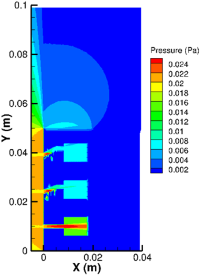
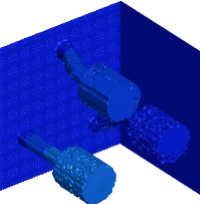
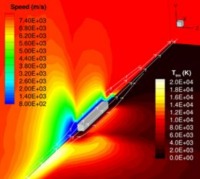
Direct Simulation Monte Carlo (DSMC) is chosen to solve the Boltzmann equation characterizing this flow: molecules move through the physical domain colliding and reacting with each other based on probabilities defined by a Total Collision Energy (TCE) model. I simulated the hypersonic reentry in C++ with the SPARTA solver. Probing the aerothermal profile in the locations of the sensors simulates the mission scientific returns. The relationship between the simulated sensor readings and reaction rate coefficients for the modified Arrhenius equation is found via machine learning.
Environment Testing
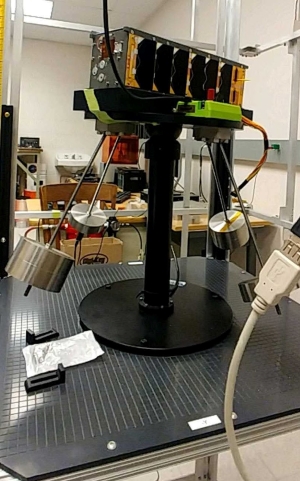
In preparation to launch, the PSP and its sensors were thoroughly tested in a vacuum chamber before being integrated with the bus.
Launch
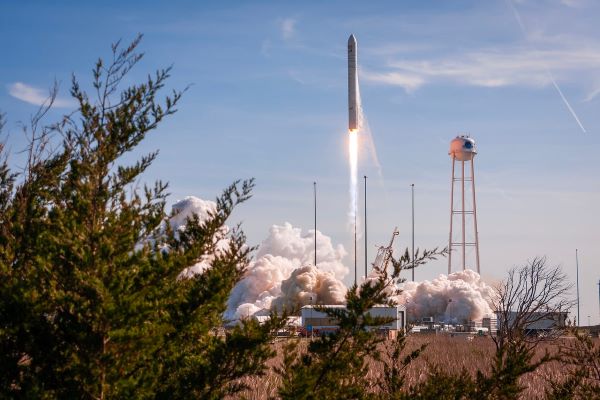
The CubeSat launched as a secondary payload to the Northrop Grumman’s 11th Commercial Resupply Services (CRS-11) mission onboard an Antares rocket from Virginia Space’s Mid-Atlantic Regional Spaceport (MARS) at NASA’s Wallops Flight Facility on April 16th, 2019/